segunda-feira, 8 de agosto de 2016

How Is Climate Change Impacting the Water Cycle?


Climate change increases our risk of both heavy rains and extreme droughts. But why – and how – is that? Aren't the two contradictory?

Science has shown that climate change touches every corner of our planet’s ecosystem, and the water cycle is no exception. Because the processes involved are highly dependent on temperature, changes in one have consequences on the other. Specifically, as global temperatures have steadily increased at their fastest rates in millions of years, it’s directly affected things like water vapor concentrations, clouds, precipitation patterns, and stream flow patterns, which are all related to the water cycle.
So how does climate change impact the water cycle? We’ve created an infographic below that illustrates what’s going on, but we’ll describe it here too. Put simply, water evaporates from the land and sea, which eventually returns to Earth as rain and snow. Climate change intensifies this cycle because as air temperatures increase, more water evaporates into the air. Warmer air can hold more water vapor, which can lead to more intense rainstorms, causing major problems like extreme flooding in coastal communities around the world.

But it doesn’t end there. At the same time that some areas are experiencing stronger storms, others are experiencing more dry air and even drought. Like we mentioned above, as temperatures rise, evaporation increases and soils dry out. Then when rain does come, much of the water runs off the hard ground into rivers and streams, and the soil remains dry. The result? Still more evaporation from the soil and an increased risk of drought.
 
Check out the infographic below to see how climate change is affecting the water cycle. And if you find it useful, share it with your friends on Facebook or Twitter. 

quarta-feira, 3 de agosto de 2016

Recordes de altas temperaturas, efeito estufa e nível do mar em 2015

Recordes registrados no ano passado:

  • Temperaturas
  • Nível dos mares
  • Emissões de gases de efeito estufa
Matéria completa:
http://www1.folha.uol.com.br/ciencia/2016/08/1797967-recorde-de-altas-temperaturas-efeito-estufa-e-nivel-do-mar-em-2015.shtml


Environmental records shattered as climate change 'plays out before us'


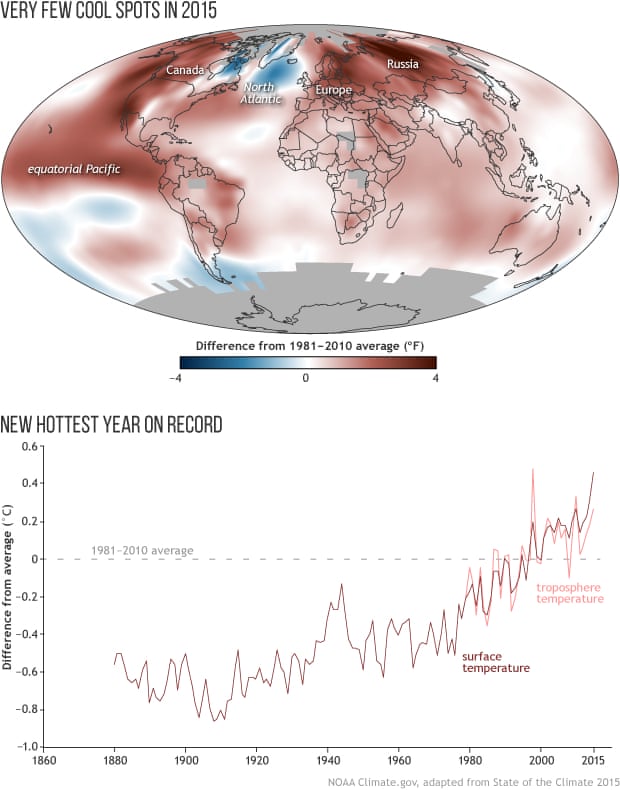
The world is careening towards an environment never experienced before by humans, with the temperature of the air and oceans breaking records, sea levels reaching historic highs and carbon dioxide surpassing a key milestone, a major international report has found.
The “state of the climate” report, led by the National Oceanic and Atmospheric Administration (Noaa) with input from hundreds of scientists from 62 countries, confirmed there was a “toppling of several symbolic mileposts” in heat, sea level rise and extreme weather in 2015.

 https://i.guim.co.uk/img/media/4907f814cac32b8b44b9fe2fb02d1eec15660105/0_0_620_790/master/620.jpg?w=620&q=55&auto=format&usm=12&fit=max&s=3da3717b0d015ec290bbb7b37abb42b9

“The impacts of climate change are no longer subtle,” Michael Mann, a leading climatologist at Penn State, told the Guardian. “They are playing out before us, in real time. The 2015 numbers drive that home.”

Read full article @ The Guardian.

quarta-feira, 27 de julho de 2016

From IOP: Physics for sustainability at #ESOF16

From the Institute of Physics ‏@PhysicsNews

"So many benefits from solar disinfection: children's attendance at schools improves, care-givers are available for income generation #ESOF16"
https://twitter.com/PhysicsNews/status/758238749247635456

"How does it work? The UV damages microbes and the slow pasteurisation stops their repair #ESOF16"
https://twitter.com/PhysicsNews/status/758237892401561600

"In Kenya, children drinking solar disinfection were found to increase in height too #ESOF16"
https://twitter.com/PhysicsNews/status/758238214842904576

"Solar water disinfection: placing water in direct sunlight for six to eight hours should make the water biologically safe #ESOF16"
https://twitter.com/PhysicsNews/status/758237392104980480

"Contaminants in wastewater that is reused unsafely can cause serious health issues, including tumour development and kidney diseases #ESOF16"
https://twitter.com/PhysicsNews/status/758233636369993728

"Despo Fatta-Kassinos explaining risks from wastewater from antibiotic resistant contaminants @PhysicsNews #ESOF16"
via https://twitter.com/danleeuk/status/758234364245372930

Brazil will have the world's sixth-largest population of over-sixties by 2025

By Elton Alisson, in Porto Seguro (Bahia)  |  Agência FAPESP – In recent decades, the Brazilian population has aged rapidly and is expected to include 31.8 million people over the age of 60 by 2025. This will have a direct impact on healthcare and social security. In particular, care for the elderly will have to change.
The above assessment was presented by researchers during a round-table session on demographics and aging in developing countries held as part of the 68th Annual Meeting of the Brazilian Society for the Advancement Science (SBPC). The meeting took place on July 3-9 at the Porto Seguro campus of the Federal University of Southern Bahia (UFSB).
“From 2 million in 1950, the number of Brazilians over 60 had jumped to 6.2 million in 1965. By the turn of the century, it reached 13.9 million. In 2025, it will reach 31.8 million and will be one of the six largest in the world,” said Luiz Roberto Ramos, a professor at the Federal University of São Paulo’s Medical School (EPM-UNIFESP), during the event.
Ramos was the principal investigator in a FAPESP-funded research project on the effectiveness of health promotion actions for the elderly.
He said the Brazilian population is aging much faster than the European population, for example. Mortality and fertility rates were both high in Europe until 1800, and this combination kept the population young. The situation changed between 1800 and 1900, during the Industrial Revolution, mainly due to a rise in life expectancy. “It took a hundred years for the European mortality rate to fall,” Ramos noted.
The fertility rate only began to fall in Europe between 1900 and 1950, he added. It is expected to hold steady in the decades ahead, leading to a rise in the proportion of older people.
In Brazil, on the other hand, mortality fell between 1950 and 1980, while fertility began declining in 1970 and is now well under 2.0 children per woman of childbearing age, less than the replacement rate. Population growth is set to stall by 2050.
“The demographic transition that took 180 years in Europe will take half as long in Brazil,” Ramos said.
The rise in the proportion of elderly Brazilians, which is growing much faster than that of any other age groups and has caused the overall aging of the population, must change the public health system’s priorities, according to Ramos.
Until 1950, when Brazil’s fertility and mortality rates were high, 40% of deaths were caused by infectious diseases and only slightly more than 10% were due to cardiovascular diseases.
Cases of infectious disease trended down between 1950 and 1970, when Brazil’s epidemiological transition began, and they now account for only 5% of all deaths compared to 40% for cardiovascular diseases.
“Under the old public health paradigm in Brazil, the population at risk was made up of children, the priority was treatment of infectious diseases; preventive measures – symbolized by vaccination – were effective, and treatments were simple, definitive and cheap. It was the famous case of one antibiotic per week,” Ramos said.
“Under the new paradigm, the population at risk is made up of older people, the priority is treatment of chronic noncommunicable diseases that cause disability, preventive measures are relatively ineffective, and treatments are complex, chronic and expensive.”
Moreover, the Brazilian health system is not equipped to address this new situation, according to Ramos.
A survey of the profession’s evolution since 1910 by the Federal Medical Council shows that 38% of Brazilian physicians were pediatricians, gynecologists or anesthesiologists in 2010. Geriatrics ranked forty-first among medical specialties, according to the report.
“We have a long way to go before our health system has enough professionals who specialize in caring for all these older people,” Ramos said.
Care for the elderly
Ana Amélia Camarano, a researcher at the Institute for Applied Economic Research (IPEA), a government think tank, presented statistics showing that the over-eighties are currently the fastest growing age group in Brazil. This age group is set to grow at an even faster rate owing to the baby boom in 1950–60, when fertility rates were still high.
“This age group benefited from the fall in infant, child and adult mortality in the past few decades in Brazil and more recently from the fall in old-age mortality due to advances in medicine,” Camarano said.
Now, however, rising numbers of over-eighties will require not only more care but also more time for care, she added, estimating that the size of the elderly cohort that requires more care may grow between 30% and 50% by 2020 in Brazil.
“We have to ask ourselves whether families are ready to care for relatives of an advanced age,” she said. “Families should be prepared for this.”
Older Brazilian men and women require long-term care for 4.2 years and 4.7 years on average, respectively. Men die earlier than women in Brazil. “So, aging is a gender issue,” Camarano said. “Many older women are prime carers for their husbands, who die first. Who will take care of these women?”
Another concern, she went on, is the social security system. The birth rate is falling, and the workforce is contracting as a result. “How many people will have jobs and pay the social security contributions that will keep these older people in pensions or benefits?” she asked.
Impact on social security
Brazil’s 1988 Constitution uncoupled old age from poverty by introducing a universal social security network that guarantees a basic income for the elderly, Camarano noted. Today, 82% of Brazilians aged 65 and over receive social security benefits.
However, because of aging, the over-65 age group will comprise approximately 20% of the population in 2050, and the social security system will have to spend proportionately more. The deficit, which is already substantial, will therefore become even larger, said Bernardo Lanza Queiroz, a professor at the Federal University of Minas Gerais (UFMG).
“Approximately 12% of public spending in Brazil goes toward the elderly even today,” Queiroz said, adding that the large numbers of Brazilians who apply for a retirement pension at a relatively early age exacerbate the problem.
In the early 1990s, when universal social security was implemented, most people over 65 were in paid employment, compared with only 20% now. The guaranteed right to an old-age pension is itself partly responsible for the decrease, according to Queiroz.
“A very large percentage of Brazilians receive pensions or other social security benefits in proportion to the number of over-65s,” he said. “In 2010, 1.6 people received retirement benefits for every person aged 65 or over. From this ratio, you can infer that people are retiring relatively early.”
Retirement at a relatively young age would not be a problem if the social security system were in sound financial health – and in any event is perfectly legal, Queiroz noted.
“The law was framed in that way for a good reason, which was to enable the poor to get a retirement pension after working for 30 years,” he explained. “However, exactly the opposite has happened: people with higher levels of schooling and better-paid jobs have traditionally taken more advantage of the opportunity to retire after contributing for 30 years.”
The longer it takes to reform social security, the steeper will be the cost to the nation and to ordinary citizens, according to Queiroz, who presented data showing that Brazil has four people receiving pensions for every ten people who pay social security contributions.
If nothing changes between now and 2050 in terms of employment and years paying contributions, for example, there will be 1.2 people receiving benefits per person paying contributions. “The math just won’t add up,” he stressed.

quinta-feira, 23 de junho de 2016

Educação em Mudanças Climáticas.


Prezado(a) FRANCISCO ALEXANDRE DA COSTA,

Uma nova DEFESA DE DOUTORADO foi registrada no SIGAA para o PROGRAMA DE POS-GRADUACAO EM CIENCIAS CLIMATICAS.

As informações do trabalho em questão são:

DISCENTE: CARLOS MAGNO LIMA FERNANDES E SILVA
DATA: 15/07/2016
HORA: 15:00
LOCAL: Auditório do Departamento de Física
TÍTULO:
Educação em Mudanças Climoambientais

MEMBROS DA BANCA:
Presidente - 1174332 - FRANCISCO ALEXANDRE DA COSTA
Interno - 348011 - GILVAN LUIZ BORBA
Externo ao Programa - 2235 - FERNANDO MOREIRA DA SILVA
Externo à Instituição - JOSÉ ESPÍNOLA SOBRINHO - UFERSA
Externo à Instituição - WYLLYS ABEL FARKATT TABOSA - IFRN


sábado, 11 de junho de 2016

Comissão de Mudanças Climáticas discutirá potencial de produção de energias renováveis

A discussão acontecerá na próxima quarta-feira (15)

O potencial brasileiro em produção de energias renováveis não hidráulicas será tema de debate na Comissão Mista de Mudanças Climáticas na quarta-feira (15). Aumentar a produção e o uso de energias renováveis faz parte do compromisso assumido pelo Brasil na 21ª Conferência das Partes da Convenção-Quadro das Nações Unidas sobre Mudanças do Clima, a COP 21, onde foi assinado o Acordo de Paris, que vigorará a partir de 2020.
No campo energético, uma das metas brasileiras é alcançar uma participação estimada de 45% de energias renováveis na matriz energética em 2030, a partir da expansão do uso de fontes renováveis. Por isso, a comissão incluiu a questão entre os temas a serem analisados em audiências públicas.
Foram convidados para o debate o coordenador da Campanha de Energias Renováveis do Greenpeace, Ricardo Baitelo; o presidente da Associação Brasileira das Indústrias de Biomassa e Energia Renovável (Abib), Celso Marcelo de Oliveira, e a presidente da Associação Brasileira das Empresas de Energia Eólica (Abeeólica), Elbia Silva Gannoum.
A audiência será realizada em caráter interativo, com a possibilidade de participação popular. Para participar com comentários ou perguntas, basta acessar o Portal e-Cidadania ou ligar para o Alô Senado, no número-0800612211.
A reunião terá início às 14h30, na sala 9 da Ala Alexandre Costa.
Agência Senado

quinta-feira, 9 de junho de 2016

USP abrirá inscrições para pós em Mudanças Climáticas e suas Interdisciplinaridades

Agência FAPESP – O Núcleo de Apoio à Pesquisa em Mudanças Climáticas (NapMC – Incline), da Universidade de São Paulo (USP), inicia em 1º de julho o processo de matrículas na disciplina de Pós-Graduação Mudanças Climáticas e suas Interdisciplinaridades.
O objetivo do curso é desenvolver conhecimentos gerais e interdisciplinares sobre aspectos relacionados às Mudanças Climáticas e suas implicações no clima passado, presente e futuro.
A disciplina será ministrada no Instituto de Astronomia, Geofísica e Ciências Atmosféricas (IAG) da USP, entre os dias 22 de agosto e 2 de setembro. A carga horária será de 60 horas ao longo das duas semanas, com aulas de segunda a sexta-feira das 9h às 12h e das 14h às 17h.
As matrículas são gratuitas e abertas a todos os alunos de Pós-Graduação da USP e também a interessados de instituições externas. Os alunos regulares deverão matricular-se entre 1º e 10 de julho pelo Sistema Janus. Alunos não regulares têm prazo até 15 de julho para fazer a matrícula pelo e-mail cpgiag@usp.br.
O curso abordará os temas Paleoclima, balanço de energia na atmosfera, biometeorologia humana, Introdução à oceanografia descritiva de importância para as mudanças e variabilidade do clima, entre outros. Para mais informações acesse o site: http://www.incline.iag.usp.br/data/index_BRA.php.

segunda-feira, 6 de junho de 2016

Climate Science: An Invitation for Physicists

Climate science is rooted in physics and in many of the methods used by physicists. Although it’s a cliché to say that the practice of science changed dramatically with the advent of the digital age, computers have had an enormous impact on the growth and evolution of climate science. Before computing, progress in explaining observations or making predictions in the physical sciences, including climate science [1], was made using pencil and paper calculations. Computers changed this completely.
There are currently two main approaches to climate theory: numerical simulations, which use large-scale general circulation models of the atmosphere and/or oceans, and idealized models—a physicist’s bread and butter—which are generally geared towards understanding the behavior of a key physical phenomenon within the larger climate system [2]. Simulations of the climate operate like enormous coarse-grained weather forecasts; the global climate is represented by the output from a computational approximation of all of the known physics. In contrast, idealized models focus on individual subsystems of the climate, such as El Niño [3] or Arctic sea ice [4]. Breaking down the problem in this way facilitates mathematical analysis of the processes involved and their observational manifestations. There is a vast gulf, both conceptually and in terms of space and time scales, between simulations and idealized models. Attempts to reconcile them will have to focus on the problem of scales, a task well suited to physicists: The challenge of scale separation in both condensed matter and particle physics led to the development of the renormalization group, unifying concepts in previously disparate fields [5]. Renormalization group concepts and methods have been successfully applied to fluid dynamics problems [6,7], which are central to climate dynamics.
Climate science gave birth to one of the most far-reaching branches of mathematics: chaos theory. Meteorologist Edward Lorenz uncovered chaos theory when developing an idealized model of thermal convection, similar to that which occurs when water is heated on a stove [8]. Some 50 years later, almost every physicist has heard of chaos, and ideas and concepts based on the theory have lengthy tendrils that extend throughout many branches of science [9]. In this sense, climate science is indeed basic science. By considering idealized models motivated by specific climate problems, could other discoveries akin to chaos be made? We know that approaches from statistical mechanics normally used to describe microscopic systems can be applied to large-scale geophysical systems, such as planetary flows, rain, and sea ice thickness [10–12]. What other concepts could shed light on idealized models and inform our thinking about geophysical flows? Lorenz advocated that examining the statistics of a flow could provide more insight into the phenomena than calculating only the flow field itself [13]. His idealizations continue to push our thinking in many new directions [14–16].
Data analysis is another important area where mainstream physics and climate science can connect. Experimental high-energy physicists, for example, are experts in locating small signals in large quantities of data so that they can correctly interpret particle collision events [17]. Could climate scientists examining data from sediment or ice cores learn from the theoretical and data analysis methodologies particle physicists use? In turn, could physicists in general learn from the methodologies employed in climate research [18–22]?
Physicists have successfully addressed a wide swath of science and engineering problems using myriad methods. Many of these applications have motivated the invention of entirely new approaches. Climate science offers many exciting opportunities for physicists with broad interests. The field is as interdisciplinary as, for example, soft matter [23], with practitioners spanning nearly all science and engineering departments. The problems are rich and vast; they range from figuring out how to approach challenges like turbulence and multiscale phenomena [24–26] to embracing the analysis of wide ranging climate proxy data [27–29]. New ideas will emerge from perspectives that come from the range of approaches used across all areas of physics. Not only will this help scientists better understand the climate, but what they learn will, as shown by the legacy of chaos theory, impact fields far beyond climate science.
J.S. Wettlaufer
Yale University, New Haven, Connecticut 06520-8109, USA
Mathematical Institute, University of Oxford, Oxford OX2 6GG, United Kingdom
Nordita, Royal Institute of Technology and Stockholm University, SE-10691 Stockholm, Sweden
REFERENCES
[1] Geophysical fluid dynamics summer program: Woods Hole Oceanographic Institution, (c.f., Program History) (2016) .
[2] I. M. Held, The gap between simulation and understanding in climate modeling, Bull. Am. Meteorol. Soc. 86, 1609 (2005).
[3] E. Tziperman, H. Scher, S. E. Zebiak, and M. A. Cane, Controlling Spatiotemporal Chaos in a Realistic El Nino Prediction Model, Phys. Rev. Lett. 79, 1034 (1997).
[4] W. Moon and J. S. Wettlaufer, A stochastic perturbation theory for non-autonomous systems, J. Math. Phys. (N.Y.) 54, 123303 (2013).
[5] L. P. Kadanoff, Innovations in statistical physics, Annu. Rev. Condens. Matter Phys. 6, 1 (2015).
[6] N. Goldenfeld, Lectures on Phase Transitions and the Renormalization Group (Addison-Wesley, Reading, MA, 1992).
[7] G. I. Barenblatt, Scaling, Self-Similarity, and Intermediate Asymptotics: Dimensional Analysis and Intermediate Asymptotics (Cambridge University Press, Cambridge, England, 1996).
[8] E. N. Lorenz, Deterministic nonperiodic flow, J. Atmos. Sci. 20, 130 (1963).
[9] J. Gleick, Chaos: Making a New Science (Viking, New York, NY, 1987).
[10] A. Venaille and F. Bouchet, Statistical Ensemble Inequivalence and Bicritical Points for Two-Dimensional Flows and Geophysical Flows, Phys. Rev. Lett. 102, 104501 (2009).
[11] M. Wilkinson, Large Deviation Analysis of Rapid Onset of Rain Showers, Phys. Rev. Lett. 116, 018501 (2016).
[12] S. Toppaladoddi and J. S. Wettlaufer, Theory of the Sea Ice Thickness Distribution, Phys. Rev. Lett. 115, 148501 (2015).
[13] J. B. Marston, Looking for new problems to solve? Consider the climate, Physics 4, 20 (2011).
[14] H. M. Arnold, I. M. Moroz, and T. N. Palmer, Stochastic parametrizations and model uncertainty in the Lorenz 96 system, Phil. Trans. R. Soc. A 371, 20110479 (2013).
[15] A. N. Souza and C. R. Doering, Maximal transport in the Lorenz equations, Phys. Lett. A 379, 518 (2015).
[16] S. Agarwal and J. S. Wettlaufer, Maximal stochastic transport in the Lorenz equations, Phys. Lett. A 380, 142 (2016).
[17] G. J. Feldman and R. D. Cousins, Unified approach to the classical statistical analysis of small signals, Phys. Rev. D 57, 3873 (1998).
[18] J. Pedlosky, Geophysical Fluid Dynamics (Springer, New York, NY, 1992).
[19] A. J. Majda and X. Wang, Nonlinear Dynamics and Statistical Theories for Basic Geophysical Flows (Cambridge University Press, Cambridge, England, 2006).
[20] R. T. Pierrhumbert, Principles of Planetary Climate (Cambridge University Press, Cambridge, England, 2010).
[21] H. Dijkstra, Nonlinear Climate Dynamics (Cambridge University Press, Cambridge, England, 2013).
[22] C. Wunsch, Modern Observational Physical Oceanography: Understanding the Global Ocean (Princeton University Press, Princeton, NJ, 2015).
[23] S. C. Glotzer, Editorial: Soft Matters, Phys. Rev. Lett. 114, 050001 (2015).
[24] E. N. Lorenz, The predictability of a flow which possesses many scales of motion, Tellus 21, 289 (1969).
[25] T. N. Palmer, More reliable forecasts with less precise computations: A fast-track route to cloud-resolved weather and climate simulators?, Phil. Trans. R. Soc. A 372, 20130391 (2014).
[26] F. Bouchet, T. Grafke, T. Tangarife, and E. Vanden-Eijnden, Large deviations in fast-slow systems, J. Stat. Phys. 162, 793 (2016).
[27] B. Saltzman, Dynamical Paleoclimatology: Generalized Theory of Global Climate Change, International Geo-physics Series (Academic, San Diego, CA, 2002), Vol. 80.
[28] A. Bunde, J. F. Eichner, J. W. Kantelhardt, and S. Havlin, Long-Term Memory: A Natural Mechanism for the Clustering of Extreme Events and Anomalous Residual Times in Climate Records, Phys. Rev. Lett. 94, 048701 (2005).
[29] D. H. Rothman, Earth’s carbon cycle: A mathematical perspective, Bull. Am. Math. Soc. 52, 47 (2015).
Published 14 April 2016
DOI: 10.1103/PhysRevLett.116.150002

Source/Fonte: http://journals.aps.org/prl/edannounce/10.1103/PhysRevLett.116.150002

terça-feira, 26 de abril de 2016

#ClimateAgreement: The Paris Agreement has solved a troubling problem

By endorsing a limit of 1.5 °C, the climate negotiations have effectively defined what society considers dangerous, says Simon L. Lewis.

The Paris Agreement for tackling climate change opens for governments to sign this week, four months after it was agreed. The momentum created by the deal, described as a multilateral political triumph, looks set to continue: China and the United States are among the 130-odd countries expected to bring the agreement into force early by adding their signatures on the first day.
Is this the beginning of the end of the fossil-fuel age, as some suggest? It could be — its influence is certainly being felt. Peabody Energy, the largest private coal company, lost 12.6% of its value the day after the Paris deal was agreed. It filed for bankruptcy last week. But even before countries queue up to sign, the Paris Agreement could already have solved one of the most troublesome problems in the climate arena, one that has plagued scientists and policymakers for almost a quarter of a century. And yet almost nobody — scientists included — seems to have noticed.
The Paris Agreement has finally defined the threshold for ‘dangerous’ climate change. It is 1.5 °C above pre-industrial levels. True, this definition is not explicitly spelled out in the agreement text. It is a de facto definition. But it is there all the same. And that is hugely significant.

Read more.