sábado, 13 de agosto de 2016

Acordo de Paris sobre o Clima é aprovado pelo Senado brasileiro.

O Plenário aprovou nesta quinta-feira (11) o projeto de decreto legislativo (PDS 19/2016) que confirma a adesão do país ao Acordo de Paris sobre o Clima, celebrado na capital francesa em 12 de dezembro de 2015, e assinado em Nova York, em 22 de abril de 2016.
Aprovado pela manhã na Comissão de Relações Exteriores (CRE), o projeto vai agora à promulgação.
Na presidência da sessão, o senador Jorge Viana (PT-AC) cumprimentou a presidente afastada Dilma Rousseff, responsável pela assinatura do acordo. Ele também destacou a atuação da ex-ministra do Meio Ambiente Izabela Teixeira nas negociações para aprovar o texto em Paris, durante a Conferência das Partes — Convenção das Nações Unidas sobre Mudança do Clima (COP21). Segundo Viana, o papel do Brasil foi fundamental para o fechamento do Acordo sobre o Clima.
O ponto central do documento é a obrigação de que todas as partes realizem esforços conter o aquecimento global. O objetivo de longo prazo é o de manter o aumento da temperatura média global abaixo de 2º C em relação aos níveis pré-industriais.
O Brasil apresentou uma série de metas no acordo, como o compromisso de reduzir as emissões de gases do efeito estufa em 37% até 2025 (em relação aos níveis de 2005), podendo chegar a 43% até 2030, e de baixar em 80% o desmatamento legal e em 100% o ilegal até 2030. Outra meta para 2030 é restaurar 12 milhões de hectares de florestas, uma área equivalente ao território da Inglaterra.

Viabilidade

Relatora do PDS 19/2016 na CRE, Kátia Abreu (PMDB-TO) apresentou números que, a seu ver, mostram a viabilidade do cumprimento das metas, consideradas ambiciosas. A parlamentar observou que, dos 851 milhões de hectares de extensão do Brasil, 517 milhões estão com vegetação nativa, ou seja, preservados.
— Estamos abrindo mão de terras agricultáveis para a preservação do meio ambiente — afirmou Kátia, que foi ministra da Agricultura.
A senadora notou que, de 1977 até agora, não houve aumento significativo da área destinada à produção de alimentos. Entretanto, a produção aumentou 220%, de 1,4 toneladas por hectares para 4,5 toneladas por hectares.
— Qual foi o milagre? — perguntou a senadora.
Segundo ela, esse salto foi impulsionado pela tecnologia da Empresa Brasileira de Pesquisa Agropecuária (Embrapa) e pela ampliação e renovação do parque de máquinas e equipamentos com financiamento do governo federal. Além disso, houve ampliação significativa da área da segunda safra, ou seja, “mais produção no mesmo chão”.

Desmatamento

Um dos pontos mais significativos das metas, que é a redução de 80% da taxa de desmatamento da Amazônia Legal, poderá ser atingido até 2020, ainda na avaliação da parlamentar. Tomando como referência os níveis de 2005, segundo ela, já houve uma redução de 75,3%.
O Programa de Agricultura de Baixo Carbono (ABC) é outro aliado na obtenção das metas acertadas em Paris, de acordo com a senadora. Só na recuperação de pastagens degradadas é prevista a liberação de 15 milhões de hectares.
Com várias outras iniciativas, ela espera como resultado total a liberação de 70 milhões de hectares — “o quanto o Brasil ainda pode produzir sem desmatar”. Nesses 70 milhões de hectares, poderão ser produzidas 379 milhões de toneladas de grãos, o que significa quase o dobro da atual produção de 190 milhões de toneladas.

Convergência

Na CRE, os senadores Jorge Viana (PT-AC), José Agripino (DEM-RN), Antonio Anastasia (PSDB-MG) e Tasso Jereissati (PSDB-CE) apoiaram o relatório de Kátia Abreu. O presidente da CRE, senador Aloysio Nunes (PSDB-SP), notou que o relatório da senadora é uma demonstração de que é possível construir ampla convergência, apesar das eventuais divergências entre os parlamentares.
Viana lembrou que é autor do Projeto de Lei do Senado (PLS) 750/2015, que transforma em lei os compromissos brasileiros no acordo de Paris. A proposta tramita na Comissão de Meio Ambiente, Defesa do Consumidor e Fiscalização e Controle (CMA).

Por Djalba Lima | 11/08/2016, para Agência Senado.

Primeira infecção humana por superbactéria é registrada no Brasil

Caso aconteceu em hospital de alta complexidade de Natal, no Rio Grande do Norte

O gene mcr-1, que causa resistência a uma classe de antibióticos utilizada para tratar infecções por bactérias multirresistentes, foi identificado pela primeira vez no Brasil em cepas da bactéria Escherichia coli isoladas de animais de produção. Os pesquisadores do Instituto de Ciências Biomédicas da Universidade de São Paulo, responsáveis pela identificação, também reportaram o primeiro caso de infecção humana no País, ocorrido em um hospital de alta complexidade em Natal, capital do Rio Grande do Norte.

Leia na íntegra: O Globo

quarta-feira, 10 de agosto de 2016

Abertura da Rio 2016 mostrou que Brasil participa de questões científicas globais

Karina Toledo  |  Agência FAPESP – Com uma audiência estimada em 3 bilhões de pessoas, foi realizado no dia 5 de agosto, no Rio de Janeiro, o maior evento de divulgação científica da história. O tema: mudanças climáticas globais.
Em cerca de 2 minutos, um filme veiculado durante a cerimônia de abertura dos Jogos Olímpicos Rio 2016 mostrou como o dióxido de carbono (CO2) emitido pelo homem se acumula na atmosfera, causando o aumento da temperatura do planeta, o derretimento das calotas polares e o aumento do nível do mar.
Com base em modelos científicos, ilustrou o que pode acontecer até o fim deste século em locais como Amsterdã (Holanda), Dubai (Emirados Árabes Unidos), Flórida (Estados Unidos), Xangai (China), Lagos (Nigéria) e Rio de Janeiro (Brasil) – caso as emissões de CO2 se mantenham nos níveis atuais.
Na sequência, apresentou uma das possíveis soluções para o problema por meio do plantio de árvores, que ajudariam a sequestrar parte do carbono emitido e fixá-lo na biosfera. Daí surgiu a proposta de que cada atleta plantasse – durante a cerimônia – uma semente e que, posteriormente, as 11 mil mudas sejam transferidas para o Parque Radical, estrutura construída para os jogos no Complexo Esportivo de Deodoro, para formar a Floresta dos Atletas. As espécies de plantas foram distribuídas de acordo com a nacionalidade dos competidores. Uma forte mensagem simbólica.
O roteiro foi idealizado e dirigido pelo cineasta Fernando Meirelles e sua produção contou com a consultoria dos pesquisadores Tasso Azevedo e Paulo Artaxo.
Azevedo, engenheiro florestal, coordenador do Sistema de Estimativa de Emissões de Gases de Efeito Estufa do Observatório do Clima (SEEG) e diretor executivo do Imaflora, tratou do tema “floresta”. Artaxo, que é professor do Instituto de Física da Universidade de São Paulo (IF-USP), membro do Painel Intergovernamental de Mudanças Climáticas (IPCC) e da coordenação do Programa FAPESP de Pesquisa sobre Mudanças Climáticas Globais (PFPMCG), ficou responsável pelas questões científicas referentes às mudanças climáticas.
Em entrevista à Agência FAPESP, Artaxo comentou qual foi sua participação na cerimônia de abertura da Olimpíada e como isso pode contribuir para a causa ambiental global.
Agência FAPESP – De quem foi a ideia de abordar o tema das mudanças climáticas globais na cerimônia de abertura e qual foi sua contribuição?
Paulo Artaxo – O Fernando Meirelles é um cineasta bastante sensível às questões ambientais e teve a ideia de incluir o tema das mudanças climáticas na cerimônia de abertura. A equipe dele me procurou para auxiliar na tarefa, de modo que não houvesse nenhum deslize científico na mensagem que seria transmitida no filme final. Meu papel foi selecionar produtos científicos confiáveis, como gráficos e animações. Fui atrás das melhores e mais atuais referências, como os produtos usando os mapas de elevação de terreno produzidos pelo United States Geological Survey e pelo International Geosphere-Biosphere Programme (IGBP). Principalmente em relação ao aumento do nível do mar, há alguns sites que exageram na questão e sugerem que o planeta inteiro pode ficar embaixo d’água, mas não é o que vai acontecer. São necessárias fontes de informações básicas, modelos confiáveis e isso não é algo trivial. Houve a preocupação de abordar a questão de maneira leve, afinal era uma festa de abertura, mas, ao mesmo tempo, passar a mensagem de que temos de cuidar do nosso planeta com urgência. Logo após a sessão dedicada à mudança climática veio o tema das florestas, que contou com a consultoria de Tasso Azevedo.
Agência FAPESP – Como o senhor avalia o resultado do trabalho e seu impacto?
Artaxo – A ideia era contar uma história e, assim, tratar das principais questões relacionadas às mudanças climáticas: aumento da temperatura do planeta, sua relação com as emissões de CO2 e de aerossóis resultantes das atividades humanas e, por último o aumento do nível do mar. Acho que o resultado final deu muito certo e ajudou a mostrar que o Brasil não se resume a samba, carnaval e Gisele Bündchen, mas também está envolvido seriamente nas questões científicas globais. Penso que tão importante quanto produzir ciência de qualidade é trabalhar para a disseminação desse conhecimento para toda a sociedade – não apenas para a comunidade acadêmica e os formuladores de políticas públicas. Acredito que a mensagem, durante a cerimônia de abertura, foi passada de modo que mesmo as pessoas sem qualquer formação científica puderam compreender e isso é extremamente importante.
Agência FAPESP – De que forma isso pode ajudar a combater o problema climático?
Artaxo – Desde o terceiro relatório do IPCC, divulgado há cerca de 15 anos, tem sido falado claramente que se não houver uma redução na emissões de gases-estufa haverá um aumento significativo na temperatura do planeta. Foi somente depois de 2007, quando o IPCC ganhou o Nobel da Paz, que o tema das mudanças climáticas ganhou visibilidade. Agora, o Acordo de Paris deixou claro que a humanidade vai atuar nessa questão para minimizar os impactos. Se o fará na velocidade necessária e da forma necessária, ninguém sabe. O fato é que os políticos, em geral, respondem às demandas da população que os elege. Mas há também fortes interesses econômicos e políticos envolvidos. E o setor de exploração de petróleo e carvão ainda é um dos maiores setores econômicos do planeta. É preciso haver muita pressão por parte da sociedade, muita política pública bem elaborada e ação governamental coordenada. No Acordo de Paris, cada país está adotando a sua meta nacional de redução de emissão de carbono, o que é absolutamente estratégico para o planeta. Claro que os compromissos feitos até o momento não são suficientes para garantir clima estável ao longo das próximas décadas, mas esperamos que os compromissos aumentem conforme se acumulam as evidências de que os impactos podem ser muito importantes, inclusive economicamente. É um complexo jogo entre a sociedade, a economia que move o planeta e os tomadores de decisão. Temos de atuar em todos os níveis e o filme da abertura da Rio 2016 ajudou a divulgar informações cruciais para a população em geral. Deixou uma mensagem inequívoca de que é preciso agir para frear as mudanças climáticas globais.

Mudanças na temperatura global de 1850 a 2016
Simulação das mudanças na temperatura global de 1850 a 2100
Clique nas imagens para abrir as animações. Os gifs foram feitos pelo climatologista britânico Ed Hawkins, da Universidade de Reading, no Reino Unido.

Zika File: Global Warming is Driving 'Neglected' Tropical Diseases Our Way

Posted By on Wed, Aug 10, 2016 at 7:15 AM


CENTERS FOR DISEASE CONTROL
Centers for Disease Control

The deadliest creatures on the planet don’t consume their prey outright. They sip them. These stealthy meals are hardly felt at all—until the itch sets in. Then you know: Mosquito.

Mosquito-borne diseases such as West Nile, chikungunya, and Zika—strange-sounding and remote to most American ears—are given little attention until they rush our shores to puncture our awareness in daily headlines and newscasts.

Until the recent rise in reports of malformed babies started generating low-grade panic in pockets of Texas and Florida and points in between, these diminutive bloodsuckers had been relegated largely to mere “pest” status. Sure there have been spikes of concern with the rise and fall of each tropical virus, but we've ignored the constant generation of potentially crippling new diseases beyond our borders.

Our circles of compassion too often collapse at national borders, allowing entrenched killers like malaria to continue to claim the lives of an estimated 600,000 men, women, and children (mostly children) every year across the planet’s tropical belt.

Today's national Zika debates over how to fund a proper response have stuck in the miasma of our polarized politics. Historically anemic funding of mosquito surveillance and control efforts here in Texas have left our political leaders discussing with straight faces how best to distribute cans of bug spray to the most at risk.

But for those who think shrunken-headed babies is the worst it can get: Prepare to be overwhelmed.

The colluding forces of poverty, globalization, and climate change have set the stage for a rapid cascading of public-health crises in the United States, according to one of Texas’ leading experts on tropical disease. In other words, as-yet-unrecognized nasties are already preparing to displace incoming Zika from the top of our news cycle.

“We’re in for a long haul of new or old infectious epidemics that are accelerating rapidly,” Dr. Peter Hotez, dean for the National School of Tropical Medicine at the Baylor College of Medicine in Houston, told Mark Goldberg on the “Global Dispatches” podcast earlier this year. “And we’re just not prepared.”

Thanks to human-caused climate change, epidemics of novel-sounding viruses are likely to accelerate in Texas. In fact, the quickening is already evident. Ten years after first showing its face in Texas, a West Nile virus outbreak in 2012 resulted in an unprecedented 1,800 infections here, resulting in 89 deaths. These days, mosquito-control yard signs staked into DFW lawns, where half of all 2012 cases occurred, are hard to miss.

The halting reemergence of dengue, or “breakbone fever,” is again badgering state residents, particularly in the Rio Grande Valley. During a 2005 outbreak, the CDC estimates that one in three Brownsville-area residents were exposed to the virus.

Sometimes mistaken for dengue in its manifestation in severe joint pain, chikungunya (menacingly translated as: “to become contorted”) started collecting its own domestic headlines in 2006 and 2007 and has since been observed in most U.S. states, including Texas, though exclusively as a travel-related import outside Florida—where Zika is also now putting down roots.

For some time, climate change’s expansion of warmer, wetter tropical weather across the U.S. South has been blamed for driving more tropical disease our way. What has been missing from that analysis is community-level research showing just how this may unfold.

That gap is beginning to be filled in thanks to the work of a Texas Tech University graduate student. As I wrote in detail for Texas Climate News recently, preliminary results from Kelly Neely’s work in buggy Brownsville is demonstrating that potential disease carriers will increase in Texas as the earth continues to warm.

That doesn’t necessarily translate into more infections; policy responses could partially mitigate the threat. Support for the World Health Organization’s call for an international campaign to fight neglected tropical diseases is vital, as is the reduction of poverty both here and abroad that allows these killers to develop and spread. At a federal and state level, it calls for ramping up monitoring, prevention, and control measures.

Locally, individuals can do their part by eliminating backyard breeding habitat and patching those screen doors and windows.

More importantly, we need to do everything we can to check the “neglected” disease march by acting aggressively to slow global warming. Sure, we can keep the fossil-fuel throttle wide open and simply wait for it to get too hot in Texas for the disease-carrying mosquitoes to breed. We could reach that threshold this century, according to Neely.

That would unseat the stealthy mosquito. It could unseat us, as well.

Even after Texas' first Zika-related death this week in Houston—a child struck with microcephaly—few are discussing Harris County's Executive Director of Public Health Dr. Umar Shah’s admonition that this potentially crippling wave of mosquito-borne illness is “not something we can spray our way out of of.”

Poverty, almost as much as the mosquitoes themselves and the warming climate moving them deeper into the United States, is a key risk factor here in San Antonio and around the world that few are willing to talk about.

Via SACurrent.

segunda-feira, 8 de agosto de 2016

Mudanças Climáticas e Jogos Olímpicos.


A parte da cerimônia da abertura das Olimpíadas que abordou a questão das mudanças climáticas teve o apoio do Prof. Paulo Artaxo, docente do Instituto de Física da USP. Ele montou a temática científica para o Fernando Meirelles na parte de clima e ao Tasso Azevedo na parte de florestas.

Abaixo, o link sobre a repercussão dessa questão publicada no Washington Post:

https://www.washingtonpost.com/news/energy-environment/wp/2016/08/05/in-olympics-opening-ceremony-brazil-goes-big-on-climate-change/

How Is Climate Change Impacting the Water Cycle?


Climate change increases our risk of both heavy rains and extreme droughts. But why – and how – is that? Aren't the two contradictory?

Science has shown that climate change touches every corner of our planet’s ecosystem, and the water cycle is no exception. Because the processes involved are highly dependent on temperature, changes in one have consequences on the other. Specifically, as global temperatures have steadily increased at their fastest rates in millions of years, it’s directly affected things like water vapor concentrations, clouds, precipitation patterns, and stream flow patterns, which are all related to the water cycle.
So how does climate change impact the water cycle? We’ve created an infographic below that illustrates what’s going on, but we’ll describe it here too. Put simply, water evaporates from the land and sea, which eventually returns to Earth as rain and snow. Climate change intensifies this cycle because as air temperatures increase, more water evaporates into the air. Warmer air can hold more water vapor, which can lead to more intense rainstorms, causing major problems like extreme flooding in coastal communities around the world.

But it doesn’t end there. At the same time that some areas are experiencing stronger storms, others are experiencing more dry air and even drought. Like we mentioned above, as temperatures rise, evaporation increases and soils dry out. Then when rain does come, much of the water runs off the hard ground into rivers and streams, and the soil remains dry. The result? Still more evaporation from the soil and an increased risk of drought.
 
Check out the infographic below to see how climate change is affecting the water cycle. And if you find it useful, share it with your friends on Facebook or Twitter. 

quarta-feira, 3 de agosto de 2016

Recordes de altas temperaturas, efeito estufa e nível do mar em 2015

Recordes registrados no ano passado:

  • Temperaturas
  • Nível dos mares
  • Emissões de gases de efeito estufa
Matéria completa:
http://www1.folha.uol.com.br/ciencia/2016/08/1797967-recorde-de-altas-temperaturas-efeito-estufa-e-nivel-do-mar-em-2015.shtml


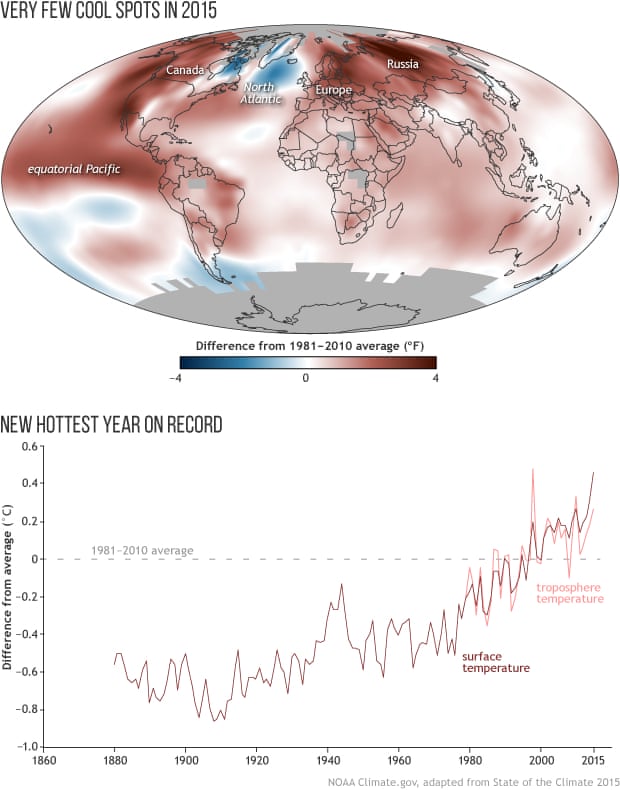
Environmental records shattered as climate change 'plays out before us'


The world is careening towards an environment never experienced before by humans, with the temperature of the air and oceans breaking records, sea levels reaching historic highs and carbon dioxide surpassing a key milestone, a major international report has found.
The “state of the climate” report, led by the National Oceanic and Atmospheric Administration (Noaa) with input from hundreds of scientists from 62 countries, confirmed there was a “toppling of several symbolic mileposts” in heat, sea level rise and extreme weather in 2015.

 https://i.guim.co.uk/img/media/4907f814cac32b8b44b9fe2fb02d1eec15660105/0_0_620_790/master/620.jpg?w=620&q=55&auto=format&usm=12&fit=max&s=3da3717b0d015ec290bbb7b37abb42b9

“The impacts of climate change are no longer subtle,” Michael Mann, a leading climatologist at Penn State, told the Guardian. “They are playing out before us, in real time. The 2015 numbers drive that home.”

Read full article @ The Guardian.

quarta-feira, 27 de julho de 2016

From IOP: Physics for sustainability at #ESOF16

From the Institute of Physics ‏@PhysicsNews

"So many benefits from solar disinfection: children's attendance at schools improves, care-givers are available for income generation #ESOF16"
https://twitter.com/PhysicsNews/status/758238749247635456

"How does it work? The UV damages microbes and the slow pasteurisation stops their repair #ESOF16"
https://twitter.com/PhysicsNews/status/758237892401561600

"In Kenya, children drinking solar disinfection were found to increase in height too #ESOF16"
https://twitter.com/PhysicsNews/status/758238214842904576

"Solar water disinfection: placing water in direct sunlight for six to eight hours should make the water biologically safe #ESOF16"
https://twitter.com/PhysicsNews/status/758237392104980480

"Contaminants in wastewater that is reused unsafely can cause serious health issues, including tumour development and kidney diseases #ESOF16"
https://twitter.com/PhysicsNews/status/758233636369993728

"Despo Fatta-Kassinos explaining risks from wastewater from antibiotic resistant contaminants @PhysicsNews #ESOF16"
via https://twitter.com/danleeuk/status/758234364245372930

Brazil will have the world's sixth-largest population of over-sixties by 2025

By Elton Alisson, in Porto Seguro (Bahia)  |  Agência FAPESP – In recent decades, the Brazilian population has aged rapidly and is expected to include 31.8 million people over the age of 60 by 2025. This will have a direct impact on healthcare and social security. In particular, care for the elderly will have to change.
The above assessment was presented by researchers during a round-table session on demographics and aging in developing countries held as part of the 68th Annual Meeting of the Brazilian Society for the Advancement Science (SBPC). The meeting took place on July 3-9 at the Porto Seguro campus of the Federal University of Southern Bahia (UFSB).
“From 2 million in 1950, the number of Brazilians over 60 had jumped to 6.2 million in 1965. By the turn of the century, it reached 13.9 million. In 2025, it will reach 31.8 million and will be one of the six largest in the world,” said Luiz Roberto Ramos, a professor at the Federal University of São Paulo’s Medical School (EPM-UNIFESP), during the event.
Ramos was the principal investigator in a FAPESP-funded research project on the effectiveness of health promotion actions for the elderly.
He said the Brazilian population is aging much faster than the European population, for example. Mortality and fertility rates were both high in Europe until 1800, and this combination kept the population young. The situation changed between 1800 and 1900, during the Industrial Revolution, mainly due to a rise in life expectancy. “It took a hundred years for the European mortality rate to fall,” Ramos noted.
The fertility rate only began to fall in Europe between 1900 and 1950, he added. It is expected to hold steady in the decades ahead, leading to a rise in the proportion of older people.
In Brazil, on the other hand, mortality fell between 1950 and 1980, while fertility began declining in 1970 and is now well under 2.0 children per woman of childbearing age, less than the replacement rate. Population growth is set to stall by 2050.
“The demographic transition that took 180 years in Europe will take half as long in Brazil,” Ramos said.
The rise in the proportion of elderly Brazilians, which is growing much faster than that of any other age groups and has caused the overall aging of the population, must change the public health system’s priorities, according to Ramos.
Until 1950, when Brazil’s fertility and mortality rates were high, 40% of deaths were caused by infectious diseases and only slightly more than 10% were due to cardiovascular diseases.
Cases of infectious disease trended down between 1950 and 1970, when Brazil’s epidemiological transition began, and they now account for only 5% of all deaths compared to 40% for cardiovascular diseases.
“Under the old public health paradigm in Brazil, the population at risk was made up of children, the priority was treatment of infectious diseases; preventive measures – symbolized by vaccination – were effective, and treatments were simple, definitive and cheap. It was the famous case of one antibiotic per week,” Ramos said.
“Under the new paradigm, the population at risk is made up of older people, the priority is treatment of chronic noncommunicable diseases that cause disability, preventive measures are relatively ineffective, and treatments are complex, chronic and expensive.”
Moreover, the Brazilian health system is not equipped to address this new situation, according to Ramos.
A survey of the profession’s evolution since 1910 by the Federal Medical Council shows that 38% of Brazilian physicians were pediatricians, gynecologists or anesthesiologists in 2010. Geriatrics ranked forty-first among medical specialties, according to the report.
“We have a long way to go before our health system has enough professionals who specialize in caring for all these older people,” Ramos said.
Care for the elderly
Ana Amélia Camarano, a researcher at the Institute for Applied Economic Research (IPEA), a government think tank, presented statistics showing that the over-eighties are currently the fastest growing age group in Brazil. This age group is set to grow at an even faster rate owing to the baby boom in 1950–60, when fertility rates were still high.
“This age group benefited from the fall in infant, child and adult mortality in the past few decades in Brazil and more recently from the fall in old-age mortality due to advances in medicine,” Camarano said.
Now, however, rising numbers of over-eighties will require not only more care but also more time for care, she added, estimating that the size of the elderly cohort that requires more care may grow between 30% and 50% by 2020 in Brazil.
“We have to ask ourselves whether families are ready to care for relatives of an advanced age,” she said. “Families should be prepared for this.”
Older Brazilian men and women require long-term care for 4.2 years and 4.7 years on average, respectively. Men die earlier than women in Brazil. “So, aging is a gender issue,” Camarano said. “Many older women are prime carers for their husbands, who die first. Who will take care of these women?”
Another concern, she went on, is the social security system. The birth rate is falling, and the workforce is contracting as a result. “How many people will have jobs and pay the social security contributions that will keep these older people in pensions or benefits?” she asked.
Impact on social security
Brazil’s 1988 Constitution uncoupled old age from poverty by introducing a universal social security network that guarantees a basic income for the elderly, Camarano noted. Today, 82% of Brazilians aged 65 and over receive social security benefits.
However, because of aging, the over-65 age group will comprise approximately 20% of the population in 2050, and the social security system will have to spend proportionately more. The deficit, which is already substantial, will therefore become even larger, said Bernardo Lanza Queiroz, a professor at the Federal University of Minas Gerais (UFMG).
“Approximately 12% of public spending in Brazil goes toward the elderly even today,” Queiroz said, adding that the large numbers of Brazilians who apply for a retirement pension at a relatively early age exacerbate the problem.
In the early 1990s, when universal social security was implemented, most people over 65 were in paid employment, compared with only 20% now. The guaranteed right to an old-age pension is itself partly responsible for the decrease, according to Queiroz.
“A very large percentage of Brazilians receive pensions or other social security benefits in proportion to the number of over-65s,” he said. “In 2010, 1.6 people received retirement benefits for every person aged 65 or over. From this ratio, you can infer that people are retiring relatively early.”
Retirement at a relatively young age would not be a problem if the social security system were in sound financial health – and in any event is perfectly legal, Queiroz noted.
“The law was framed in that way for a good reason, which was to enable the poor to get a retirement pension after working for 30 years,” he explained. “However, exactly the opposite has happened: people with higher levels of schooling and better-paid jobs have traditionally taken more advantage of the opportunity to retire after contributing for 30 years.”
The longer it takes to reform social security, the steeper will be the cost to the nation and to ordinary citizens, according to Queiroz, who presented data showing that Brazil has four people receiving pensions for every ten people who pay social security contributions.
If nothing changes between now and 2050 in terms of employment and years paying contributions, for example, there will be 1.2 people receiving benefits per person paying contributions. “The math just won’t add up,” he stressed.